


Across the beverage industry, ordering patterns have shifted from predictable to dynamic. A store might run out of stock in the middle of the day and expect replenishment within hours. A delivery platform might need to fulfil bulk orders before noon and single-bottle requests by evening. This kind of responsiveness isn’t possible without digital systems working in the background.
E-commerce has become the backbone of this speed. What started with consumer-facing websites has evolved into a layered network of marketplaces, quick commerce apps, and B2B order platforms. It reaches kirana shops, cafés, distributors, and homes. In categories like beverages, where demand is constant, and peaks are seasonal, this network helps move products quickly and visibly.
At Hindustan Coca-Cola Beverages (HCCB), this shift is embedded into how our products move every day. Our portfolio includes Coca-Cola, Thums Up, Sprite, Kinley, Minute Maid, Charged, and other beverages consumed across occasions and regions. To support this evolving demand, we introduced CokeBuddy, a digital ordering platform that helps our retail partners place orders, track them in real time, and access our portfolio more easily. What once relied on phone calls or in-person visits now happens faster, with greater accuracy and visibility.
What Does E-commerce Actually Mean?
E-commerce refers to the buying and selling of goods and services using digital platforms. It includes everything from mobile apps and online stores to order management portals and payment gateways. The entire process, from selecting a product to making a payment to arranging delivery, happens digitally.
In the context of FMCG, e-commerce simplifies access to fast-moving products. It allows retailers to restock more efficiently. It helps manufacturers and distributors operate with better forecasting. And it offers customers a faster and more convenient shopping experience.
In a fast-paced category like beverages, this approach helps ensure that products reach the shelf or the consumer without delay. It is not only about speed but also about precision, reliability, and adaptability.
The Main Types of E-commerce Models
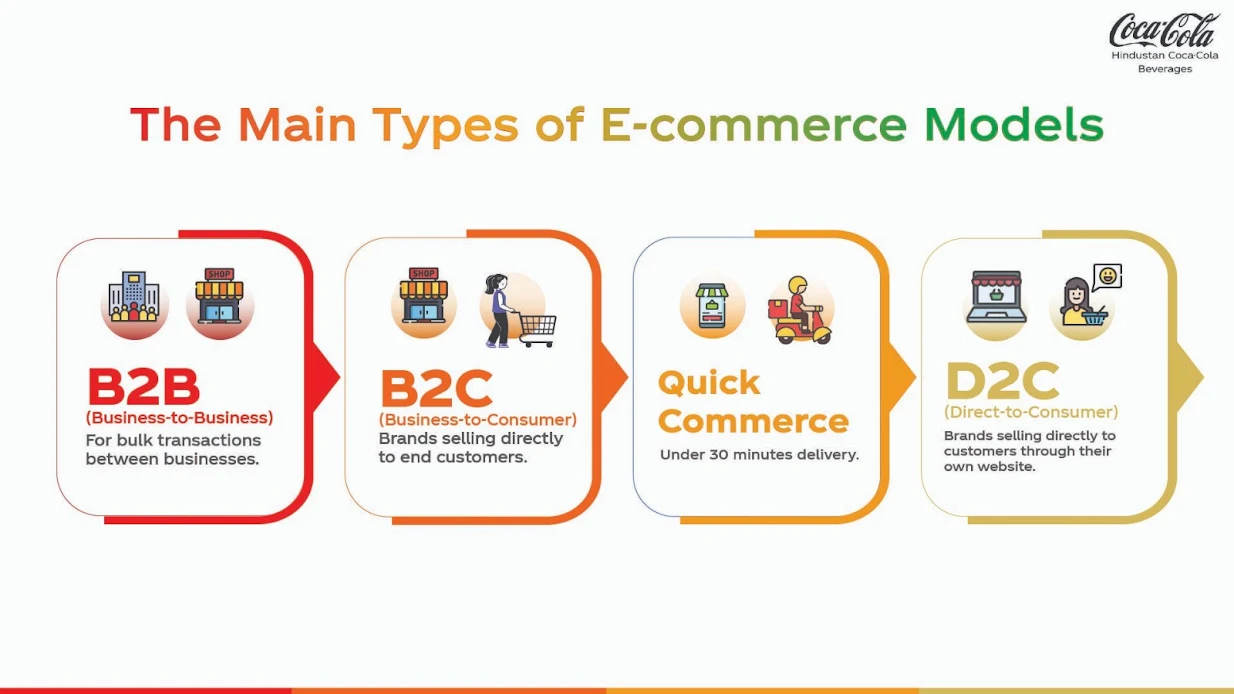
E-commerce operates in different formats depending on who is buying and who is selling. In the beverage business, each of these models plays a specific role in helping products move.
1. Business-to-Business (B2B)
This model is built for bulk transactions between two businesses. Distributors, wholesalers, and retail stores often place orders directly with manufacturers using dedicated platforms. At HCCB, this happens through CokeBuddy, where retail partners can view our portfolio, check availability, place orders, and manage their account.
The B2B format provides more control to our partners. It reduces wait times, cuts down on paperwork, and brings clarity to the ordering process. Retailers no longer need to depend entirely on scheduled visits or calls. They can place an order when the need arises and plan stock more efficiently.
2. Business to Consumer (B2C)
This model connects brands and businesses directly to the end customer. Products like Kinley water or Minute Maid juices are often available on e-commerce platforms such as Amazon, Flipkart, and BigBasket. Customers can browse, order, and receive products without stepping out.
This model works well in urban markets where digital adoption is high. It also supports availability during off-hours or in locations where physical retail is limited.
3. Quick Commerce
Quick commerce refers to instant delivery services that operate on short turnaround times. These platforms, including Zepto and Blinkit, deliver products in under 30 minutes in many cities. Beverages fit naturally into this model because they are often purchased in the moment.
Quick commerce supports impulse needs, sudden events, and restocking at odd hours. For the beverage category, it has opened up new occasions and customer touchpoints that were not accessible through traditional models.
4. Direct to Consumer (D2C)
In this model, brands create their own digital storefronts to sell directly to individual consumers. This gives companies more control over pricing, promotions, and customer data. While not yet widespread in beverages, the D2C model is slowly gaining relevance, especially for speciality products or limited edition ranges.
Why E-commerce Works Well for the Beverage Industry
Beverages are highly consumable, frequently restocked, and sold across diverse formats. They move quickly and often respond to weather, festivals, or sudden spikes in demand. This makes them an ideal category for e-commerce.Some of the key benefits of applying e-commerce to beverage distribution include:
- Reduced lead time: Orders can be placed and fulfilled without waiting for a sales representative.
- Improved visibility: Retailers and distributors know what is available and when it will arrive.
- Better stock management: Stores can avoid over-ordering or stockouts by placing smaller, more frequent orders.
- Expanded reach: Even smaller outlets in remote areas can place direct orders without relying on intermediaries.
- Simplified tracking: Orders, invoices, and deliveries can be monitored and recorded digitally.
E-commerce makes it easier to keep pace with the everyday movement of beverages. It replaces guesswork with data and adds speed without losing control. For brands evaluating the commercial impact of these improvements, ROI calculation in FMCG can help connect operational efficiencies with business outcomes.
How CokeBuddy Supports Our Retail Partners
CokeBuddy is our response to the need for smarter, more flexible ordering. It was built to support the thousands of retailers and distributors we work with every day. Instead of relying entirely on phone calls or field visits, CokeBuddy gives our partners a digital option that fits naturally into their routine.
The platform allows users to:
- Browse our complete beverage portfolio, including current availability
- Place orders anytime during their working hours
- Track delivery timelines and plan their shelf space accordingly
- View ongoing schemes, discounts, or bundled offers
- Check past order history to plan better for the future
CokeBuddy reduces the pressure on manual coordination. It gives retailers autonomy while still keeping them connected to our team and systems. By offering real-time updates and easy access, it becomes a tool for business continuity, not just convenience.
What This Means for Retailers and Distributors
E-commerce is not limited to large cities or high-volume stores. It is equally useful for smaller retailers who want more control over how they stock and sell. Whether operating a supermarket or a local kirana store, the benefits remain consistent.
Retailers who adopt platforms like CokeBuddy gain:
- More flexibility in placing orders according to their demand cycles
- Better planning due to order history and live inventory access
- Fewer errors in the order-to-delivery process
- Faster response times during busy seasons or high-demand days
- Transparent access to schemes and offers without waiting for updates
It also gives distributors clearer visibility into what is moving, where gaps exist, and how to optimise delivery routes.
Looking Ahead: Blending Physical and Digital Strengths
At HCCB, we believe in strengthening both our physical network and our digital capabilities. E-commerce works best when it complements traditional distribution, not when it replaces it. Our teams on the ground continue to support our partners through visits, consultations, and direct engagement.
Digital tools like CokeBuddy are designed to work alongside these systems. They fill the gaps where speed or access is critical. They provide consistency across regions. And they help every part of the supply chain stay informed, regardless of location or scale.
This balance between the physical and digital approach makes our system more resilient and responsive.
E-commerce Is Built into Everyday Operations
E-commerce is no longer a separate channel or an optional tool. It is now an essential part of how products move, how businesses plan, and how brands stay connected to demand. In the beverage category, where time, volume, and freshness all matter, it has become central to everyday operations.
At HCCB, we continue to improve how our systems respond to this shift. With CokeBuddy and similar tools, we aim to make ordering simpler, tracking easier, and delivery more dependable.
What matters most is helping our partners stay ready, ready to meet demand, ready to grow, and ready to serve their customers with confidence.

Comments